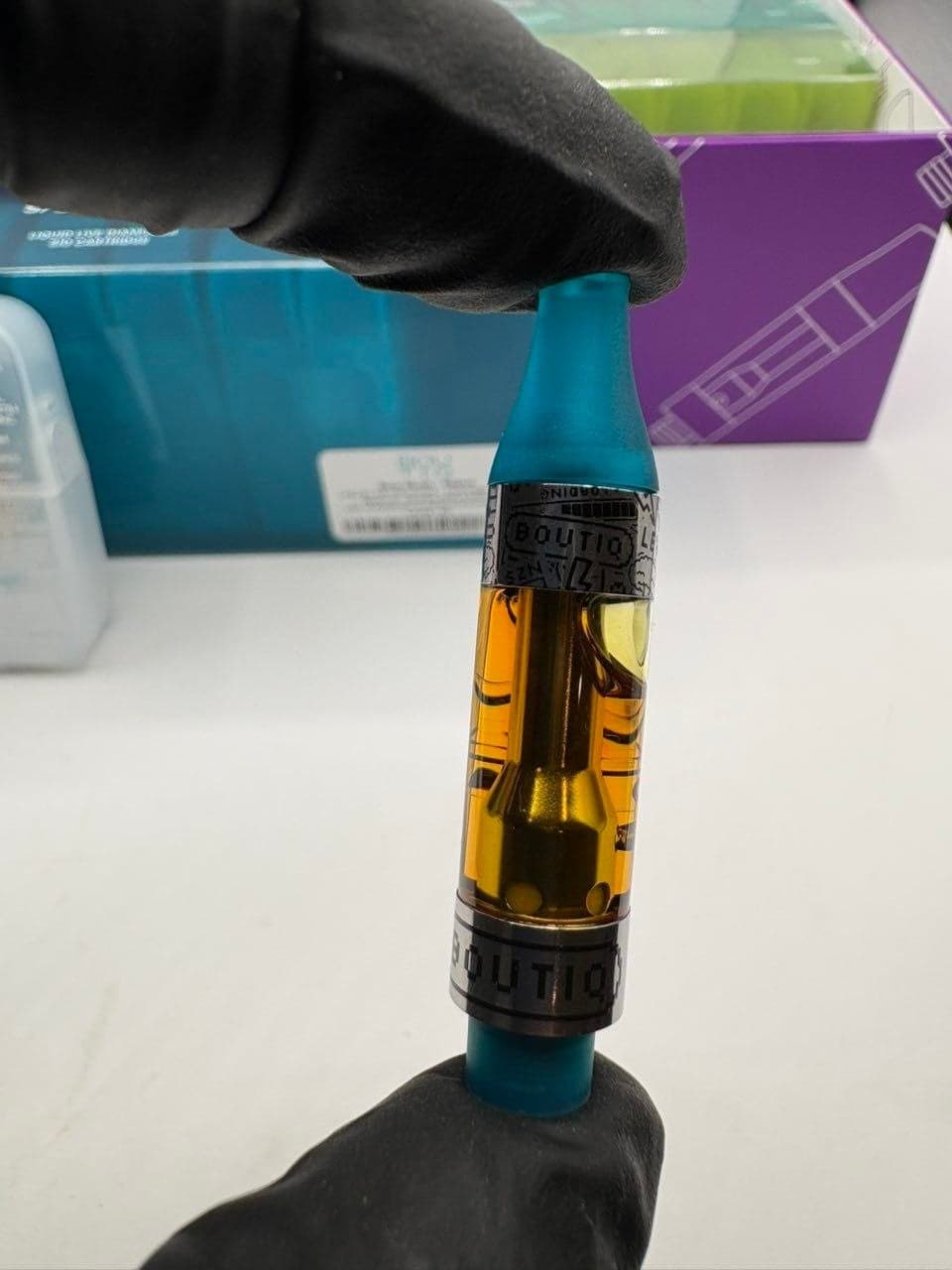
Boutiq 1G Screw-On Cartridge
$12each
Your cart is empty
Everything we sell is batch-tested, and we tell you what ships to your state before you add it.
Browse the shop
Total THC is calculated, not measured. The standard formula is 0.877 multiplied by the THCA figure, plus any delta-9 THC already present. The 0.877 is a mass ratio from decarboxylation. Knowing the arithmetic lets you check a certificate against a label rather than trusting either.
Editorial Team · Compliance and product research · Updated
Total THC is the figure most often quoted and least often explained. It is worth understanding because it is the number that regulation is written around, and because it is arithmetic rather than a measurement — which means you can check it yourself.
The standard calculation, used in United States Department of Agriculture rules and by laboratories generally, is:
Both inputs come from the laboratory. The output does not — it is derived.
It is a mass ratio, explained in what THCA is. THCA carries a carboxyl group that leaves as carbon dioxide when heated, and that group has mass.
THCA weighs about 358 per molecule; delta-9 THC about 314. Divide one by the other and you get roughly 0.877. So a gram of pure THCA becomes about 0.877 grams of delta-9 THC, and about 0.123 grams leaves as gas.
The number is not a policy choice. It is the arithmetic of a molecule losing a piece of itself.
Suppose a certificate reports THCA at 20% and delta-9 THC at 0.2%.
Now suppose it reports THCA at 0.3% and delta-9 at 0.05%.
Two minutes with a calculator, and you are no longer taking anybody's word for the headline figure.
Federal hemp rules define hemp by total THC on a dry weight basis, not by delta-9 alone. Under 7 CFR 990.1, the threshold is 0.3% total THC, calculated the way above.
That has a consequence worth stating plainly: because the acid counts towards the total after conversion, the most THCA a sample containing no delta-9 could carry and still sit under the threshold is 0.3 ÷ 0.877 = about 0.342%.
This article states the arithmetic and the rule. It makes no claim about what any product on this site contains — that is what a certificate is for.
You will still see labels and marketing quoting delta-9 alone, because that was the older way of expressing it and because it produces a much smaller number.
Neither figure is dishonest on its own. What matters is knowing which one you are looking at. A delta-9 figure and a total THC figure for the same material are not comparable, and putting them side by side is how people reach wrong conclusions in both directions.
A certificate often reports total cannabinoids as well, and it is a different figure entirely — the sum of everything the panel measured, including CBD, CBG, CBN and the rest.
A high total cannabinoid figure tells you the material was rich in cannabinoids generally. It says nothing specific about THC, and treating the two as interchangeable is a common and consequential mistake.
The guide to certificates of analysis covers the rest of a record, and what a batch code is covers the code itself.
One more term worth knowing. Percentages in this context are usually expressed on a dry weight basis — moisture removed from the calculation — because water content varies and would otherwise move every percentage without anything about the material changing.
If a certificate reports moisture content alongside the cannabinoid figures, that is why.
Sold to adults 21 and over. This article explains the subject in general. What any particular product contains, and in what quantity, comes from the certificate of analysis issued against the batch code on its packaging — not from an article, not from a product page, and not from anything printed on a box.
A certificate usually lists a dozen cannabinoids beyond THC. CBG is the precursor everything else is built from, CBN is a degradation product that rises with age and heat, and CBD is the most abundant of the non-THC compounds. Reading the whole list tells you more about a batch than the headline figure.
Heat accelerates conversion and thins oil until it floods a coil. Light drives the same reactions faster. Air oxidises THC into CBN. All three are why a device kept in a car performs differently from one kept in a drawer, and why opaque packaging is not a styling decision.
THCA is the acidic form the plant actually produces. It carries an extra carboxyl group, and applying heat removes that group as carbon dioxide, converting it to delta-9 THC. The conversion is why laboratories report two different numbers and why a label and a test can appear to disagree.